Predictors of Suicidal Ideation among Children Using Community Child Centers and the Moderating Role of Gender
Article information

Abstract
Background
This study examined the changes in suicidal ideation over time among vulnerable children attending community child centers, identified risk and protective factors associated with suicidal ideation, and tested the moderating effect of gender on these relationships.
Methods
This secondary data analysis used data from the third panel of the Panel Study of Community Child Centers, which followed children who were fourth graders in 2018, at two time points: Wave 1 (2018) and Wave 3 (2020). The final sample comprised 365 children with complete data on all study variables. The dependent variable was Wave 3 suicidal ideation; predictors included depression, self-esteem, abuse, neglect, stress, peer alienation, teacher support, and the child deprivation index. Data were analyzed via hierarchical multiple regression and gender-moderation analysis.
Results
Wave 1 suicidal ideation was prospectively associated with suicidal ideation two years later (β=0.271, P<0.001). Among risk factors, abuse (β=0.156, P=0.002), neglect (β=0.106, P=0.043), and stress (β=0.146, P=0.013) were significant. Gender moderated the association between neglect and suicidal ideation (B=0.234, P=0.049): neglect was associated with higher suicidal ideation among girls (B=0.264, P=0.005) but not among boys.
Conclusions
Suicidal ideation was significantly predicted by prior suicidal ideation, abuse, neglect, and stress. However, the association of neglect was observed exclusively among girls, underscoring the importance of gender-sensitive support in community child center settings.
INTRODUCTION
Suicidal ideation is a major concern in child and adolescent health because it can precede suicide attempts and may persist or recur [1,2]. In the United Kingdom, suicide was the leading cause of death among children and adolescents aged 5–19 years in 2020 [3]. Studies have reported that 29.9% of children and adolescents experienced suicidal ideation and 9.7% reported suicidal behavior [4,5]. Because the transition from suicidal ideation to a suicide attempt may occur within a relatively short period, early identification and intervention are critical [1].
Community child centers are community-based facilities that support children's healthy development by providing comprehensive child welfare services, including after-school care, child and parent counseling, and educational, protective, and emotional support. As such, they detect early warning signs and connect children with various community resources for immediate intervention. Over 80% of children using community child centers are classified as care-vulnerable children [6], underscoring the importance of attending to the psychosocial context that distinguishes them from the general child population. These children commonly experience multiple, co-occurring risk factors, including economic poverty, gaps in caregiving, weakened family functioning, and potential exposure to abuse and neglect, and have been reported to exhibit higher levels of depression and more frequent suicidal ideation than children in the general population [7].
Research on the factors associated with suicidal ideation among Korean children broadly encompasses both intrapersonal and environmental dimensions. At the intrapersonal level, depression, stress, and self-esteem are consistently identified as factors closely related to suicidal ideation [2,8]. Environmental variables include abuse and neglect, economic poverty, peer alienation, and teacher support [9]. However, because suicidal ideation is shaped by the complex interaction of risk and protective factors, as opposed to a single factor, a comprehensive examination of these factors is proposed.
Risk factors encompass individual or environmental conditions, such as poverty, depression, stress, and abuse and neglect, that increase the likelihood of maladaptive outcomes [10]. In contrast, protective factors are those internal assets or external resources that buffer against negative influences and promote positive adaptation even under such risk conditions [11,12]. Protective factors that may reduce suicidal ideation and buffer the effects of psychological distress include self-esteem and supportive relationships with peers and teachers [13,14].
However, much of the research has used cross-sectional data that capture associations at only a single point in time. Longitudinal research that tracks how early risk and protective factors predict later suicidal ideation remains insufficient [14,15]. In particular, few studies have examined the changes in suicidal ideation among vulnerable children, which restricts the scope of effective interventions.
Furthermore, because the transition from childhood to adolescence is a period marked by major physical and emotional changes in boys and girls, the possibility that how suicidal ideation manifests across genders warrants consideration. Notably, among adolescents who begin experiencing suicidal ideation, the proportion who go on to make an actual suicide attempt within the first year has been reported at approximately 41% for girls compared to 23% for boys, indicating a greater risk among girls [16]. Girls tend to internalize problems more than boys and be more sensitive to changes in peer relationships [17]. Girls’ greater sensitivity to relational dynamics makes them more likely to develop depression or suicidal ideation following negative peer experiences, such as bullying [18]. Nevertheless, little research has tested whether gender moderates the association of specific risk or protective factors on suicidal ideation. Empirical verification of such moderating effects is required to develop differentiated, gender-informed prevention strategies. Accordingly, this study examined the predictors of suicidal ideation assessed two years later among children attending community child centers and whether these associations differed by gender.
Purpose of the study
The study had the following objectives. First, it described changes in suicidal ideation and in the proportion of children at risk from Wave 1 to Wave 3. Second, it examined whether risk and protective factors measured at Wave 1 predicted suicidal ideation at Wave 3. Third, it examined whether gender moderated the relationships between these factors and suicidal ideation and explored significant interaction effects using simple slope analysis.
METHODS
Research design
This longitudinal panel study examined changes in suicidal ideation among children attending community child centers, assessed the factors predicting suicidal ideation two years later, and tested whether these associations varied by gender.
Participants and data collection
This study used data from the third panel of the Panel Study of Community Child Centers [19], an annual longitudinal survey conducted in July and August among children attending community child centers. The third panel followed children enrolled in the fourth grade in 2018 (Wave 1) and sixth grade in 2020 (Wave 3).
The third panel initially included 891 children, of whom 659 participated from Wave 1. Of these, 365 children with complete data on all study variables were included in the analysis.
This secondary data analysis was approved by the Institutional Review Board (IRB No. 202605-HR-031-02). The data were de-identified before being released for analysis. All measures were drawn from the original Panel Study of Community Child Centers survey [19].
Measurements
Dependent variable: suicide ideation
Suicidal ideation was assessed using the item “I have thoughts of wanting to die” from the depression subscale of the Simplified Psychiatric Diagnostic Test. The item was measured at Waves 1, 2, and 3 on a 4-point scale ranging from 1 (not at all) to 4 (very much so). Higher scores indicated greater suicidal ideation.
Independent variables
Depression
Depression was assessed using nine items from the Simplified Psychiatric Diagnostic Test's depression subscale, excluding the suicidal ideation item. The relevant items were reverse-coded, and the mean score was calculated. Higher scores indicated greater depression.
Self-esteem
Self-esteem was measured with the Korean version of the 10-item Rosenberg Self-Esteem Scale. Negatively worded items were reverse-coded, and the mean score was computed across all items. Higher scores indicated greater self-esteem.
Abuse
Abuse was assessed using four items measuring physical and verbal abuse by parents or caregivers. The relevant items were reverse-coded and averaged, with higher scores indicating greater exposure to abuse.
Neglect
Neglect was measured using four items from a parenting attitude scale. Item scores were averaged without reverse-coding, with higher scores indicating greater neglect.
Stress
Stress was assessed across four areas: academic performance, appearance, peer relationships, and economic difficulties. The relevant items were reverse-coded and averaged, with higher scores indicating greater stress.
Peer alienation
Peer alienation was measured with the three-item alienation subscale of a peer attachment scale adapted from the Inventory of Parent and Peer Attachment. The items were reverse-coded and averaged, with higher scores indicating greater peer alienation.
Teacher support
Teacher support was measured using five items assessing children’s satisfaction with teachers at community child centers. The relevant items were reverse-coded and averaged, with higher scores indicating greater teacher support.
Child deprivation index
The child deprivation index was assessed using items adapted from the UNICEF child deprivation measure. Items indicating deprivation were coded as 1 and summed, yielding a total score ranging from 0 to 15. Higher scores indicated greater deprivation.
Control variables and moderators
Gender and perceived household economic status were included as control variables. Wave 1 suicidal ideation was also included in all regression models to account for prior suicidal ideation. Because perceived household economic status was first measured at Wave 2, this score was used as the closest available measure. Responses ranged from 1 (low income) to 7 (high income). Gender was examined as a moderator of the relationships between the independent variables and suicidal ideation at Wave 3.
Data analysis
Data were analyzed using IBM SPSS Statistics version 27.0 (IBM Corp.). The 2018 survey (Wave 1) served as the baseline, and the 2020 survey (Wave 3) was the 2-year follow-up. All independent variables were measured at Wave 1, while suicidal ideation measured at Wave 3 was the dependent variable. Frequencies, percentages, means, and standard deviations were first calculated to summarize participants’ general characteristics and the distribution of the main variables. Pearson correlation coefficients were then used to examine the relationships among the variables. A hierarchical multiple regression analysis was performed using ordinary least squares estimation to identify factors associated with suicidal ideation at the 2-year follow-up. Gender, economic status, and baseline suicidal ideation were entered in the first step; depression, abuse, neglect, stress, and the child deprivation index were added in the second step, followed by self-esteem, peer alienation, and teacher support in the third step. Panel weights were not applied because they were designed for the full panel sample, not for the subsample analyzed in this study.
Additional hierarchical regression analyses determined whether gender moderated the relationships between the main predictors and suicidal ideation at the 2-year follow-up. Continuous predictors were mean centered. Interaction terms between gender and each predictor were then added to a model including all covariates and predictors in the final model, and significant interactions were further examined using simple slope analysis.
RESULTS
Participant characteristics and descriptive statistics
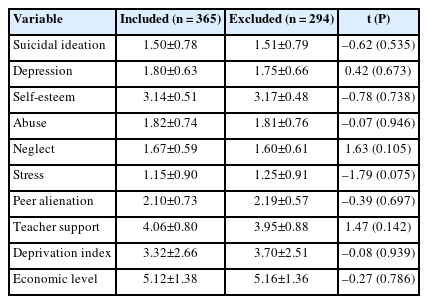
The final sample comprised 365 children: 49.3% were boys and 50.7% were girls. Most children lived in two-parent households (73.8%), while 23.4% lived in single-parent households. The proportion classified as at risk of suicidal ideation decreased from 12.3% at Wave 1 to 8.8% at Wave 3. Descriptive statistics for the study variables are presented in Table 1. Children included in the analysis did not differ significantly from those excluded on any Wave 1 characteristic (Appendix 1).
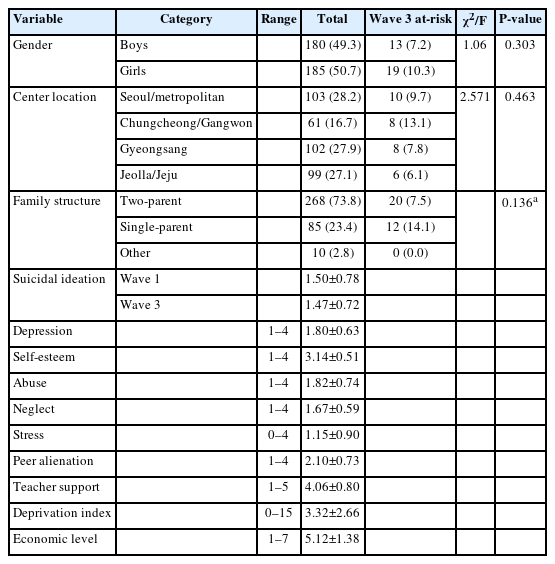
General characteristics and descriptive statistics (N=365)
Correlations among study variables
Suicidal ideation at Wave 3 was positively correlated with suicidal ideation (r=0.367, P<0.001), stress (r=0.280, P<0.001), depression (r=0.257, P<0.001), and other risk-related variables at Wave 1. In contrast, it was negatively correlated with self-esteem (r=−0.253, P<0.001) and economic level (r=−0.281, P<0.001). Teacher support was not significantly correlated with suicidal ideation at Wave 3 (Table 2).
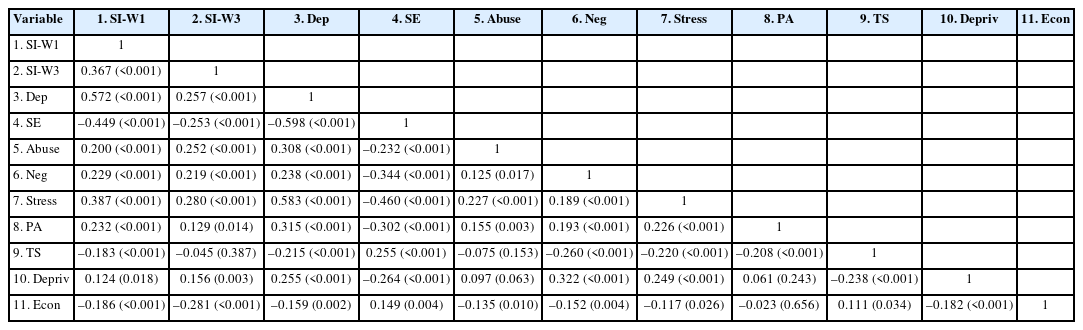
Correlations among variables
Factors associated with suicidal ideation at Wave 3
The assumptions for hierarchical multiple regression were examined before the analysis. Residual plots supported normality and homoscedasticity, and the Durbin–Watson statistic was 2.10, indicating independence of residuals. Tolerance values ranged from 0.429 to 0.923, and VIF values ranged from 1.083 to 2.330, indicating no multicollinearity problem.
Model 1, which included gender, economic level, and suicidal ideation at Wave 1, was significant and explained 18.4% of the variance (F=27.11, P<0.001). Lower economic level (β=–0.220, P<0.001) and higher suicidal ideation at Wave 1 (β=0.327, P<0.001) were associated with higher suicidal ideation at Wave 3, whereas gender showed no significant association (β=0.048, P=0.313).
Model 2, which included depression, abuse, neglect, stress, and the deprivation index, significantly increased the explained variance to 23.9% (ΔR2=0.055, P<0.001). Within this model, abuse (β=0.160, P=0.001), neglect (β=0.101, P=0.046), and stress (β=0.143, P=0.014) were identified as significant predictors, whereas depression and the deprivation index were not.
Model 3, which added self-esteem, peer alienation, and teacher support, increased the explained variance to 24.8%, although the increase was not significant (ΔR2=0.009, P=0.240). None of the protective factors was significant. In the final model, lower economic level (β=–0.189, P<0.001), higher suicidal ideation at Wave 1 (β=0.271, P<0.001), abuse (β=0.156, P=0.002), neglect (β=0.106, P=0.043), and stress (β=0.146, P=0.013) remained significantly associated with suicidal ideation at Wave 3 (Table 3).
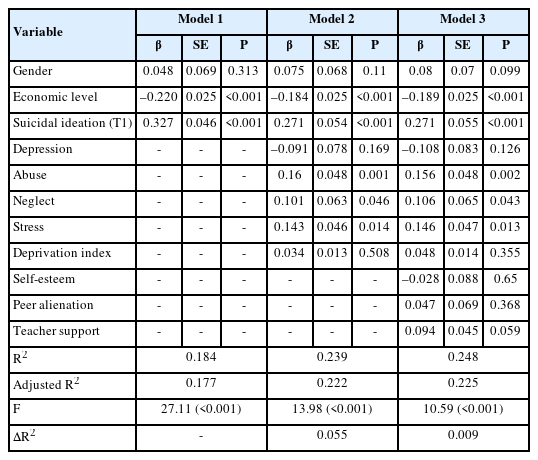
Hierarchical multiple regression analysis of Wave 3 suicidal ideation (N=365)
Moderating effect of gender
In the final model controlling for all covariates and predictors, only the neglect×gender interaction was significant (B=0.234, P=0.049, ΔR2=0.008). Simple slope analysis revealed that neglect was positively associated with suicidal ideation among girls (B=0.264, P=0.005), but not boys (B=0.029, P=0.723). The peer alienation×gender interaction was non-significant (P=0.118) (Table 4).
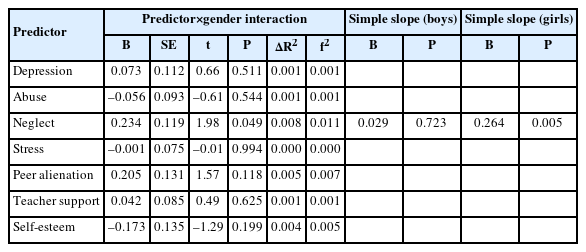
Gender-moderating effects and simple slope analysis for Wave 3 suicidal ideation (N=365)
DISCUSSION
Suicidal ideation at Wave 1 was the strongest predictor of suicidal ideation at Wave 3, even after accounting for the other variables. Childhood suicidal ideation, once present, is likely to persist over time in the absence of appropriate support [2]. Given that suicidal ideation can precede suicide planning and attempts [20], identifying children with such thoughts at an early stage is critical for preventing more serious outcomes [21]. Regular assessment and follow-up are recommended even when a child's suicidal thoughts appear to be temporary or mild.
Abuse, neglect, and stress were also associated with suicidal ideation two years later, suggesting that adverse experiences in children's daily lives may be associated with later suicidal ideation. Children who experience abuse frequently develop negative self-views, contributing to the development of suicidal ideation [16,22]. Reid-Russell et al. [22] found that reduced self-esteem mediated the relationships between abuse and both depression and suicidal ideation.
Neglect appears to operate somewhat differently from overt abuse. A persistent lack of emotional attention and care can leave children feeling unsupported, particularly when they have few alternative sources of support. Stress, in turn, tends to accumulate across several areas of children's lives, such as schoolwork, peer relationships, and economic difficulties. Studies of Korean adolescents have similarly reported that stress from academic contexts and daily life predict suicidal ideation [23,24]. Taken together, these results suggest the need for interventions that address severe adverse experiences, such as abuse, as well as less visible difficulties, including emotional neglect and chronic daily stress.
Depression and the child deprivation index were both correlated with suicidal ideation. However, they did not reach significance in the multivariable analysis, suggesting that their associations may overlap with those of other risk factors in the model. Depression was strongly correlated with stress, and research suggests that depression and rumination may mediate the relationship between stress and suicidal ideation [2,24,25]. Similarly, poverty and socioeconomic hardship may influence suicide risk through more proximal psychological or behavioral pathways [26,27]. Future research could use mediation models to help clarify how stress, depression, and economic deprivation are linked to suicidal ideation.
Teacher support showed no significant association with suicidal ideation. Although teacher support is generally considered beneficial for children's emotional well-being, its effects likely depend on the type and context of support provided [28]. The measure used here focused primarily on satisfaction with everyday relationships and may not capture support during an acute psychological crisis. Consistent with this, community child center teachers have reported difficulty providing adequate psychological support owing to heavy caseloads and limited counseling training [29]. Teacher support potentially serves more as a buffer against specific risk factors than as a direct predictor of suicidal ideation [30,31], a distinction that future studies should test directly by investigating the quality and specific types of support provided in these settings.
Gender moderated the association between neglect and suicidal ideation. Among girls, neglect was associated with higher suicidal ideation, whereas this association was not significant among boys. This pattern aligns with evidence that girls tend to internalize emotional difficulties and are more sensitive to disruptions in close relationships [32]. Repeated neglect can heighten anxiety and psychological vulnerability by depriving children of consistent emotional care [33]. However, the effect size of this interaction was small (f2=0.011); thus, this finding should be regarded as exploratory and requires replication. The interaction between peer alienation and gender was not significant.
These findings yield several practical implications. Children who report suicidal ideation require ongoing monitoring even in the absence of an immediate crisis. Interventions should target abuse, neglect, and persistent stress, with links to child protection and mental health services where needed. Because community child centers regularly interact with children, they are well positioned to detect changes in mood, behavior, and relationships; regular psychological screening, clear referral procedures, and staff training could strengthen their role in providing early identification and support. For girls, attention to experiences of neglect may be warranted, although this finding requires replication.
This study has several limitations. First, suicidal ideation was measured using a single item within a depression subscale rather than a standalone validated scale, limiting reliability assessment and the evaluation of dimensions such as frequency, intensity, and specificity. Thus, the findings should be interpreted cautiously, and future studies should use comprehensive, multidimensional instruments. Second, while children included in the final analysis did not differ significantly from excluded peers across observed baseline characteristics, potential attrition bias driven by unobserved factors cannot be entirely excluded. Employing advanced missing data techniques, such as multiple imputation, offers a promising direction for future studies. Third, participants were limited to children using community child centers, the findings should be interpreted with caution. Additionally, comparisons with the general child population are needed. Finally, because this was an observational study, causal relationships cannot be inferred.
In conclusion, this study found suicidal ideation, abuse, neglect, and stress to be predictors of later suicidal ideation among children using community child centers and the association of neglect with suicidal ideation was significant only among girls. These results underscore the need for early identification, continued follow-up, and attention to relational vulnerabilities that vary across genders.
Given community child centers’ regular contact with children, they are well positioned to recognize early signs of risk and channel children toward appropriate services. Embedding routine screening, addressing adverse experiences and chronic stress, attending to experiences of neglect, particularly among girls, could meaningfully advance suicide-prevention efforts for this vulnerable population.
Notes
AUTHOR CONTRIBUTIONS
Dr. So Yeon Park had full access to all of the data in the study and takes responsibility for the integrity of the data and the accuracy of the data analysis. All authors reviewed this manuscript and agreed to individual contributions.
Conceptualization: SYP. Methodology: all authors. Software: all authors. Formal analysis: all authors. Investigation: all authors. Data curation: all authors. Writing–original draft preparation: all authors. Writing–review and editing: all authors.
CONFLICTS OF INTEREST
No existing or potential conflict of interest relevant to this article was reported.
FUNDING
None.
DATA AVAILABILITY
The data presented in this study are available upon reasonable request from the corresponding author.